
 by | Last Updated:
UltraVR Explainer
Meta Phoenix: The 110-Gram, No-Controller Headset Coming September 23, Explained
A setup video for an unannounced headset is already running inside millions of Quest headsets. Here is everything the leaks, the memos, and Meta’s own hints tell us about Phoenix, and what the September 23 reveal will (and won’t) be.
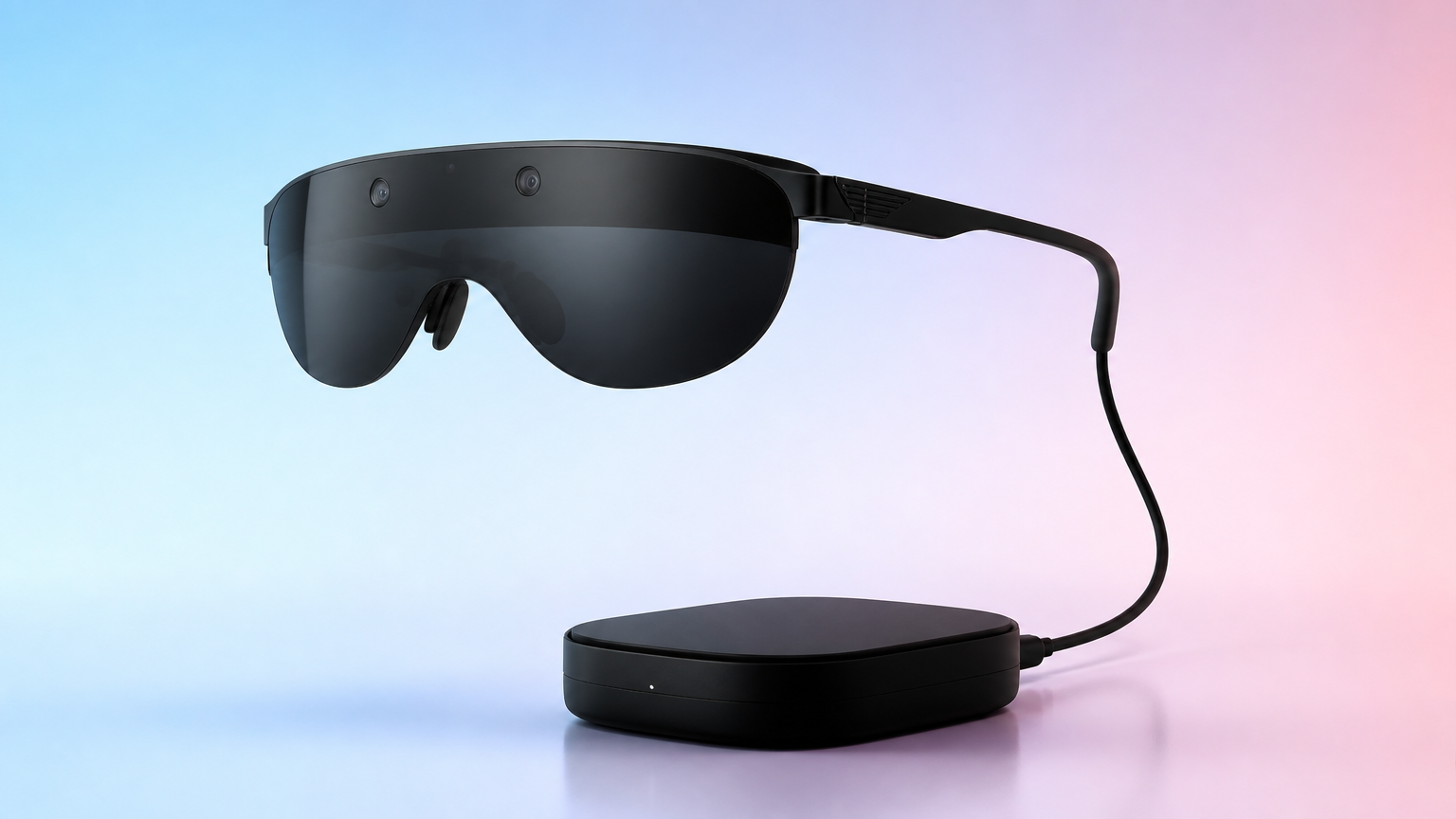
Meta has kept exactly zero secrets about its next headset. The full first-run setup video for the device, codenamed Phoenix, was found inside Quest firmware on July 29, sitting on headsets people already own (Road to VR, Tech Times). Five weeks later, on September 23, Meta takes the Connect stage in Menlo Park, and CTO Andrew Bosworth has already told the world to expect headset news. So let’s gather the evidence in one place, because Phoenix is the strangest and most interesting thing Meta has built since the original Quest: a VR headset shaped like sunglasses, with no controllers, weighing about as much as the glasses it imitates.
What is Meta Phoenix?
Phoenix is an ultralight mixed reality headset that runs Horizon OS, but with its brain moved off your face. The part you wear is a slim, glasses-like frame holding only displays, lenses, cameras, and sensors. All the heavy parts, the processor and the battery, live in a tethered “compute puck” you clip to your waist or drop in a pocket. Three codenames have circulated for this program over the years: Puffin (first mentioned in 2024), Loma (2025), and Phoenix (internal documents from December 2025), and current reporting treats Phoenix as the final product vision (space4games).
The pitch, in the leaked materials and the reporting around them, is media, productivity, and everyday mixed reality: virtual screens, floating monitors, social and fitness apps, worn in short comfortable sessions. It is not being built for room-scale gaming. That job belongs to a separate, more traditional headset Meta is developing under the codename Griffin, which is not expected before the second half of 2027 (vr.org).
What the leaked setup video actually shows
On July 29, X user ToastConcern found screenshots of Phoenix’s new-user setup video embedded in Quest’s operating system, and researcher NoriDoesVR then triggered the full setup flow on a modified headset and captured the whole video (Tech Times). Meta intentionally blurred the footage, but the design commitments are clear, and they closely match a concept sketch published in January 2026 by leaker Luna, who reported seeing physical development units (Road to VR). What the video confirms:
Schematic based on the leaked Quest firmware setup footage and prior reporting by Road to VR, UploadVR, and Tech Times. Not to scale; final design may differ.
- A slim, glasses-like profile with an open periphery. No bulky facial interface. UploadVR describes the design as “open periphery,” and vr.org notes the setup flow walks users through adjusting nose pads for comfort. There is no face gasket at all.
- Independent lens spacing per eye (interpupillary distance adjustment) and removable nose clips for individual fit.
- Eye tracking and hand tracking as the only inputs. The setup flow’s centerpiece is eye and hand calibration. There are no controllers anywhere in it. Interaction is gaze-and-pinch, the model Apple popularized with Vision Pro.
- A tethered compute puck with a cable loop or clip for wearing at the waist, running Horizon OS, pairing with your phone for things like ordering custom prescription lenses.
The 110-gram claim, pressure-tested
The number everywhere is “under 110 grams on the head,” about a fifth of a Quest 3’s 515 grams (Tech Times). It sounds like a breakthrough. The market ledger assembled by vr.org says it is actually harder than it looks, because no device that light currently does very much.
Weight on the head, from vr.org’s ledger of shipped and leaked devices. *Beyond 2’s 107 g is quoted without strap or facial interface; nobody has said whether Meta’s figure is measured the same way. Steam Frame and Quest 3 include strap and battery; Vision Pro’s battery is off-head.
Read down that list and a rule emerges: everything under roughly 132 grams is either a pair of display panels with temples or a camera-equipped smart assistant with no display. The lightest fully standalone spatial computer, Snap’s Specs, weighs 132 grams, and real headsets begin around four times heavier. Phoenix would be the first device to land in the glasses weight class while carrying cameras, tracking, and real compute, and it gets there by cheating, in the smartest possible way: the puck.
The closest proof that 110 grams is achievable is the Bigscreen Beyond 2: 107 grams with 2560 x 2560 micro-OLED panels and pancake lenses, at $1,019. But the Beyond 2 has no computer, no battery, no cameras, and no inside-out tracking. It needs a gaming PC, external controllers, and wall-mounted base stations. Meta’s reported panel order, split between BOE and Seeya, matches the Beyond 2’s resolution and panel size almost exactly (vr.org). Phoenix is effectively trying to build a Beyond 2 with the cameras and the computer included, and the computer on a leash.
No controllers is not a missing feature. It’s the whole point.
Every Quest since the original has shipped with two tracked controllers. Phoenix ships with none. That is a category statement: controllers are for grabbing, swinging, and shooting, and Phoenix is aimed at virtual screens, media, social apps, and seated mixed reality, steered by where you look and a finger pinch. One engineering detail makes the choice more than preference. At 2560 x 2560 per eye, Phoenix would carry roughly twice the pixel count of a Quest 3, and no mobile-class processor can render that everywhere at once. Eye-tracked foveated rendering, drawing full detail only where you look, is the only known way to drive those panels from tethered mobile silicon. On this headset, your eyes are not just an input method. They are part of the rendering pipeline.
If you came for Beat Saber, that is the honest trade: Phoenix is not your next gaming headset, and neither is anything Meta ships in 2026. The gaming successor, Griffin, is a “large upgrade” over Quest 3 according to the December 2025 internal memos reported by Business Insider, but it arrives no earlier than late 2027 and, notably, without Meta’s traditional price subsidization, which suggests a higher sticker (UploadVR).
How we got here: the leak timeline
- June 2025The Wall Street Journal reports Meta wants the ultralight puck-tethered headset to cost less than $1,000 (UploadVR).
- December 2025Internal memos obtained by Business Insider push the launch to the first half of 2027 and describe a second, gaming-focused headset as a “large upgrade” over Quest 3 (Road to VR).
- February 2026Low-resolution graphics of the headset and puck surface in Quest firmware, and leaked renders circulate (Tom’s Guide).
- March 2026Leaker Brad Lynch reports Phoenix is readying for production with 2560 x 2560 resolution per eye.
- June 2026Meta Connect is confirmed for September 23-24 in Menlo Park, and the codename Phoenix is found in Quest firmware (UploadVR).
- July 9, 2026Bosworth, asked in an Instagram AMA “Did you guys give up on VR?”, answers: “No… We’ve talked openly about the fact that we’re building multiple next-generation headsets… Stay tuned for Connect and we’ll have more to share then” (UploadVR).
- July 29, 2026The complete setup video leaks from firmware already running on millions of Quest headsets (Road to VR).
- September 23-24, 2026Meta Connect. The reveal.
What it will cost: a target under pressure
No price is confirmed. The last hard number is the WSJ’s “under $1,000” target from June 2025, and nearly everything about component costs has moved the wrong way since then. Qualcomm’s Snapdragon prices rise by double digits for orders shipping after September 1, DDR5 contract pricing has roughly doubled year over year, and micro-OLED is the most expensive display technology in the industry (Road to VR, space4games, which now pegs the likely price under $1,500). Remember also that Phoenix is two products in one box: the glasses and a puck with its own silicon, battery, and enclosure. The nearest comparison point, the display-only Beyond 2, costs $1,019 and still needs a gaming PC on top. Expect premium.
What to expect on September 23 (and what not to)
Temper the headline in your head. Based on the roadmap reporting, Phoenix ships in the first half of 2027, so Connect is too early for a launch and probably too early for full specs and a price. Bosworth’s “more to share” most plausibly means a formal reveal or an extended hands-on preview, not preorders (vr.org). And Phoenix will be fighting for the spotlight: Meta has already teased new smart glasses for the event, and after 7 million pairs of smart glasses sold in 2025, glasses may well headline the keynote (UploadVR). When Phoenix does appear, watch three things: whether Meta quotes the 110 grams with or without the strap, what the puck costs, and how the nose-pad fit system works in real hands. Those, not the weight number itself, are the details that decide whether this category works.
Should you wait for it?
If you game in VR, no: Phoenix is not aimed at you, nothing new ships from Meta this year, and the gaming headset (Griffin) is a late-2027 story at the earliest. A discounted Quest 3 remains the sensible buy. If what you want is virtual monitors, movies, and something you can put on for twenty minutes without a headache, Phoenix addresses that use case more directly than anything on sale, but you are waiting until 2027 at minimum, and possibly paying $1,500 for the privilege. The community mood is split right down the middle: an r/OculusQuest thread this week asking who is looking forward to Phoenix drew 191 comments where the top reply, at 124 upvotes, was “Nope. I’m done with Meta and their walled ecosystem,” while other top replies argued “comfort is king” and praised the micro-OLED contrast leap. The hardware leak itself, back in March, scored 575 upvotes at 97% positive. People want the device. The question is whether they trust the company selling it.
Sources
- Road to VR: Meta’s First Thin & Light VR Headset Reportedly Leaks in User Setup Video Ahead of Connect (Jul 29, 2026)
- Tech Times: Meta Phoenix Firmware Leak Confirms Compute Puck Design (Jul 29, 2026)
- vr.org: Meta’s Phoenix Has to Match a 107-Gram Headset and Add Cameras to It (Jul 29, 2026)
- vr.org: Meta Teased Headset News for Connect. The Roadmap Says Do Not Expect a Quest 4. (Jul 16, 2026)
- UploadVR: Meta Reaffirms “Multiple Next-Generation Headsets”, Hints At Connect Announcement (Jul 9, 2026)
- UploadVR: What Might Meta Connect 2026 Bring? (Jun 10, 2026)
- space4games: Meta’s Next XR Glasses: All the Rumors Around Puffin, Loma and Phoenix (Jul 3, 2026)
- Road to VR: Meta Delays Puck-Tethered XR Headset to 2027 (Dec 10, 2025)
- UploadVR: Meta’s Ultralight Headset With Puck Could Be Around $1000 (WSJ) (Jun 4, 2025)
- Tom’s Guide: Meta’s lightweight VR headset and compute puck revealed in leaked renders (Feb 6, 2026)
- Community: r/OculusQuest threads “Who else is seriously looking forward to Meta Phoenix?” (Aug 20, 2026) and “Meta’s ‘Phoenix’ headset readies for production with a resolution of 2560 x 2560 per eye” (Mar 15, 2026)
Leaked and reported details describe an unannounced product; Meta has not confirmed specifications, pricing, or dates. UltraVR will update this article live from Meta Connect on September 23.