
 by | Last Updated:
Steam Frame · Launch Analysis
The Steam Frame’s 21.6 Wh Battery: All Measurements, Benchmarks and Fixes
The biggest battery number on Valve’s store page belongs to the controllers. For the headset itself, the first reviews measured 52 to 180 minutes depending on what you play. Here is what 21.6 watt-hours actually converts to, what a three-hour evening costs in extra hardware, and why the strap decides everything.
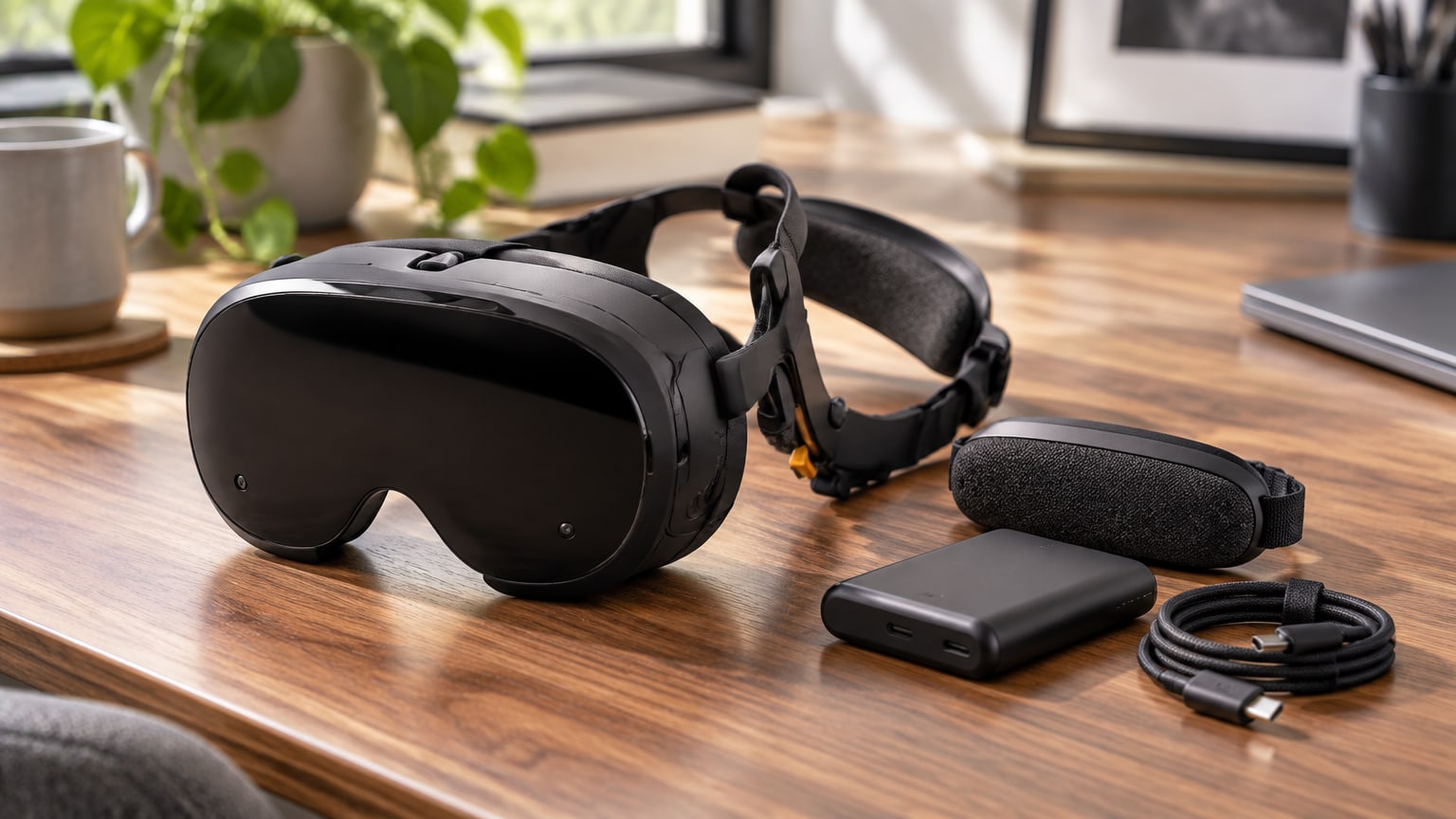
The most prominent battery claim Valve published for the Steam Frame is “~40 hours of play time.” It refers to the controllers, which each run on a single AA cell. For the headset’s own 21.6 watt-hour lithium-ion pack, Valve’s product page offers a capacity figure and no headline runtime, and the loudest number in its early messaging was a range handed to Digital Foundry last November: 1 to 4 hours of gameplay, depending on frame rate.
The first wave of reviews landed with the launch today, and the measured numbers sit at the bottom of that range for anything demanding. Battery life is already the most common complaint on r/SteamFrame within hours of the reservation lottery opening, with prospective buyers deciding before Thursday’s cutoff whether the pack is a dealbreaker. Nobody has printed the arithmetic that turns 21.6 Wh into watts, session lengths, and dollars. That is this article.
What the reviewers actually measured
The spread is wide, and it is not noise. It is workload: the difference between rendering Half-Life: Alyx locally on the Snapdragon 8 Gen 3 and letting a PC do the work while the headset decodes a video stream.
Steam Frame runtime, as measured by launch-day reviews
Minutes per full charge. The shaded band is Valve’s stated 1–4 hour range, reported by Digital Foundry from its November 2025 hands-on.
Gamers Nexus is the cleanest single datapoint because it ran the Frame and a Quest 3 through an identical test: PCVR streaming at 120Hz over the wireless adapter. The Frame lasted 84 minutes. An r/SteamFrame thread on the result rounds it to 80. CNET’s Scott Stein summed up the launch position bluntly in the roundup: battery life of no more than two hours is a problem at this price.
21.6 Wh is really a power-draw number
Divide the pack’s capacity by each measured runtime and the spec sheet turns into a consumption rate. That is the figure Valve never printed, and it explains the complaint threads better than the runtime numbers do.
Implied system draw: 21.6 Wh ÷ measured runtime
Watts the headset must burn to hit each reviewer’s number. Dashed lines: the Quest 3’s draw in Gamers Nexus’ identical test, and the Steam Deck OLED running its worst-case 3-hour battery figure.
Steam Deck owners recognize the shape of this problem. The Deck OLED carries 50 Wh and Valve rates it for 3 to 12 hours, which works out to about 4 to 17 watts. The Frame’s heaviest load sits at the top of that same band, fed by less than half the energy. A Reddit user in the battery complaint thread put the comparison the way most buyers will feel it: the Deck manages 5+ hours streaming games over a local network, and they expected something similar from the Frame.
The reason for the draw is inference, not a Valve spec: 16GB of RAM (double the Quest 3’s), two Wi-Fi 7 radios, always-on eye tracking driving foveated streaming, and decoding 2160×2160 per eye at up to 144Hz is a sustained max-load job for a phone chip. Valve’s software engineer Jeremy Selan conceded as much before launch: “The battery, the thermals; I think those will be the ultimate limits of the device.”
A bigger battery than the Quest 3, and a shorter runtime
Here is the comparison that surprises people. The Frame’s 21.6 Wh pack is 11% larger than the 19.44 Wh cell iFixit found inside the Quest 3. In Gamers Nexus’ matched test, it ran out 34 minutes earlier.
Steam Frame vs Quest 3: the battery ledger
Pink: Steam Frame. Gray: Quest 3. Runtime is the Gamers Nexus matched 120Hz PCVR streaming test.
Battery capacity (watt-hours)
Runtime in GN’s matched test (minutes)
Efficiency (minutes per Wh)
Efficiency is where the gap lives. The Frame squeezes 3.9 minutes out of each watt-hour in that test; the Quest 3 gets 6.1. Meta’s cheaper headset also charges at 18 watts with a charger in the box, while the Frame ships with no power supply and recommends a 45W or higher USB-C brick. There is a structural reason the Frame spends more: it runs an x86 Steam library on an ARM chip through Valve-funded FEX translation and Proton, where the Quest 3 runs native Android builds. Translation costs cycles, and cycles cost watts.
The fix, priced: what a 3-hour evening actually costs
The community’s instinct is right: a pocket power bank solves this today, because the Frame plays while it charges. The sizing math, with a realistic 85% conversion allowance for the boost from the bank’s cells to USB voltage:
Power bank sizing for the Steam Frame
Added runtime assumes the 15.4 W draw of 120Hz PCVR streaming. Nominal Wh = mAh × 3.7V. Usable Wh assumes ~85% end-to-end conversion. Prices and weights are typical for mainstream USB-C PD banks.
| Bank | Nominal | Usable | Added at 120Hz | Total session | Weight | Typical price |
|---|---|---|---|---|---|---|
| Internal battery only | 21.6 Wh | 21.6 Wh | n/a | 84 min | 0 g | included |
| 5,000 mAh | 18.5 Wh | ~15.7 Wh | ~61 min | ~2.4 h | ~100 g | $15–20 |
| 10,000 mAh | 37 Wh | ~31.5 Wh | ~2 h | ~3.5 h | ~200 g | $25–35 |
| 20,000 mAh | 74 Wh | ~63 Wh | ~4 h | ~5.5 h | ~400 g | $45–60 |
Can one charge survive a 3-hour evening?
Total playable time at 120Hz streaming (84 min baseline + bank contribution). The black line marks a 180-minute session.
One caveat on the passthrough math: while you play at 15.4 watts, the bank’s contribution only offsets the drain. A bank feeding ~10 watts into the headset still leaves a slow deficit at 120Hz, so session totals will run slightly short of the table’s clean addition, and lighter workloads will run longer. The charging circuit itself is under suspicion: Gamers Nexus measured more than three and a half hours for a full recharge on a headset Valve promised would take two. Valve told GN the result was valid but said its internal testing produced different numbers, which leaves open whether launch-day software is costing owners charge speed alongside runtime.
The strap is the roadmap
The structural fact that reframes all of this: the battery is not in the visor. It sits in the rear strap, along with the speakers and the microSD slot, while the 185-gram core module (chip, RAM, storage, optics, cameras) detaches with three switches. Valve designed the Frame so that everything likely to be upgraded lives in the part you can swap.
“We’re working on a future first-party accessory where it will plug in and replace the existing [strap]. That head strap will include a hot-swappable battery, and then premium Index-style off-ear audio.”
Jeremy Selan, software engineer, Valve, in a pre-launch interview with PC Gamer
When PC Gamer pressed for a date, Selan joked that he had been confident the Frame would ship in early 2026 and no longer felt like a credible source on timing. His actual commitment: “we’re working to make it available as soon as we can.” Hardware engineer Joy Lyons confirmed it is “coming soon,” with pricing and details to follow. No date, no price.
Two consequences that no review addressed, both raised on r/SteamFrame. First, the launch strap is a placeholder for Valve’s own upgrade path: day-one buyers are carrying the beta hardware, and when the hot-swap strap ships, today’s strap loses its reason to exist. Second, anyone who swaps to a third-party comfort strap (the BoboVR-style solution Quest owners already use) orphans the battery, speakers, and SD slot in one move. The strap is where the e-waste lands.
The realistic read: hot-swappable batteries turn session length into a non-issue the day that accessory ships, which retroactively shrinks today’s complaint. But “coming soon” from Valve after the Frame itself slipped from early 2026 to September is a promise without a calendar. Buyers who need long cordless sessions before the strap exists are buying the power bank anyway.
Does the battery change what you should reserve?
Price the runtime itself and the picture sharpens. At the realistic entry price of $1,088 (base kit plus the $29 charger Valve does not include), the Frame delivers 120Hz streaming at about $13 per minute of battery life. The Quest 3 at $600 delivers about $5. Add a $30 bank to the Frame and the figure falls to $5.40, nearly parity.
Cost per minute of 120Hz streaming runtime
Real-world entry prices: Frame $1,059 + $29 charger; Quest 3 $599.99 since Meta’s April increase.
Should the 21.6 Wh pack change your reservation before Thursday?
Do your sessions usually run past 90 minutes, seated, away from an outlet?
Watching for the hot-swap strap instead?
Bottom line
The battery is the Frame’s weakest spec and the reviews prove it: 52 minutes at full standalone load, 84 minutes at 120Hz streaming, against a Quest 3 that runs 40% longer on a smaller cell. It is also the most fixable spec Valve has shipped in years, because the fix costs $30 today and is built into Valve’s own accessory roadmap. If runtime is your only objection, the math says reserve and buy a bank. If a $1,059 headset needing a pocket battery to finish a movie is the dealbreaker, that is a legitimate one too, and the lottery closes Thursday either way.One last number for the reservation holdouts. MintySodaCan, in the battery complaint thread, landed the sharpest version of the complaint: “Not being able to get through one (1) movie is kind of ridiculous.” At 10.8 watts of streaming draw, the Frame clears a two-hour film with minutes to spare, and a 5,000 mAh bank covers the extended edition. The math is forgiving. The spec sheet just never showed it.
Sources
- Gamers Nexus, “Valve Steam Frame VR Review vs. Meta Quest 3 | Privacy, Latency, & Benchmarks” (Sept 14, 2026); battery benchmark segment.
- PC Gamer, “Valve working on Steam Frame strap that adds Index-like speakers and hot-swappable batteries, ‘coming soon'” (Jeremy Selan and Joy Lyons interview).
- Space4Games, “Steam Frame Reviews Are In: Here’s What Critics Think” (Sept 14, 2026): CNET, IGN, PCGH, Gamers Nexus, LTT, Tested figures.
- VR.org, Steam Frame spec sheet and launch pricing coverage (Sept 14, 2026).
- Valve Steam Frame product page: 21.6 Wh battery, “Power Supply not included,” controller AA runtime.
- r/SteamFrame, “Only 80 minutes of PCVR at 120hz on a full battery?” and “The battery life is ruining it for me” (Sept 14, 2026).
- UploadVR, “Quest 3 Teardown Reveals It’s Mostly Battery Inside” (iFixit: 19.44 Wh cell).
- Meta, “How to charge your Meta Quest headset”: Quest 3 averages 2.2 hours, charges at 18W.
- Steam Deck tech specs: 40Wh LCD (2–8 h), 50Wh OLED (3–12 h).
- Digital Foundry hands-on (Nov 2025): Valve’s 1–4 hour claim.
Analysis and all wattage, efficiency, and power-bank calculations are UltraVR’s own, derived from the cited measurements. Usable power-bank capacity assumes ~85% conversion efficiency; your cable, bank, and workload will move the numbers. The Dave2D figure is a community-reported number from r/SteamFrame, not independently verified.